


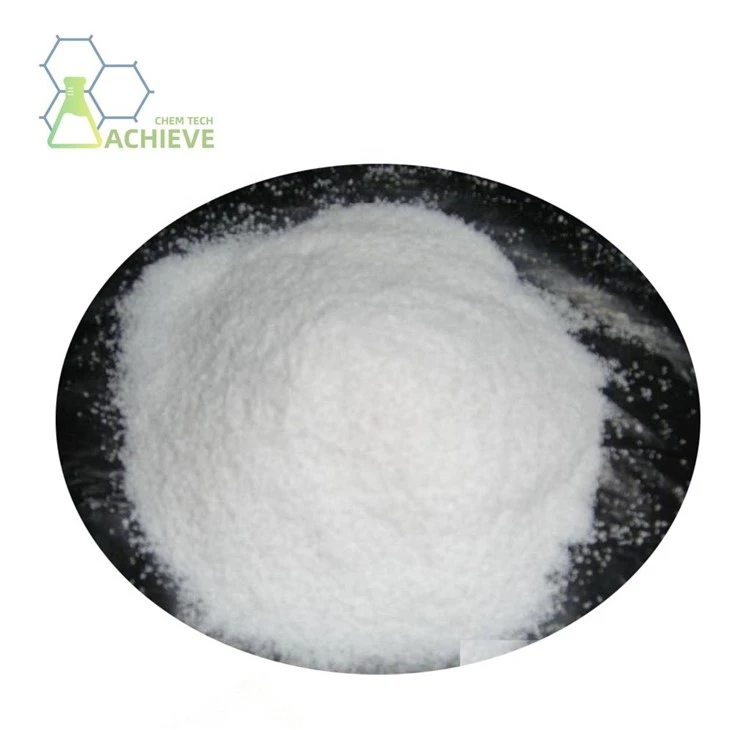

(TBAI) is an important quaternary ammonium salt compound with the chemical formula [(C₄H₉)₄N]⁺I⁻. Its appearance is usually a white to off-white hygroscopic crystal or powder. The most remarkable characteristic of this compound is its outstanding ability as a phase transfer catalyst (PTC). The large lipophilic tetrabutylammonium cation in its molecular structure can effectively transfer inorganic anions (such as iodide ions I⁻) from the aqueous phase to the organic phase, thereby significantly accelerating the heterogeneous reactions between the aqueous and organic phases. It is widely used in various organic synthesis reactions such as nucleophilic substitution, esterification, and oxidation, improving reaction rates and yields. Additionally, TBAI is also a key precursor for synthesizing other tetrabutylammonium salts (such as tetrabutyl bromide, tetrabutyl hydroxide, etc.) and is used as a supporting electrolyte in electrochemical research. In materials science, it is used to prepare iodide nanocrystals or precursor materials for perovskite. It should be noted that this compound is sensitive to light and should be stored in a dark place. It may also have certain irritancy to the skin and eyes. When operating, appropriate protective equipment should be worn. In summary, tetrabutyl iodide, with its unique structure and function, has become a highly practical and versatile chemical reagent in organic chemistry, industrial production, and scientific research.

|
|
|


| C16H36IN | |
| 369.19 | |
| 369.38 | |
|
m/z |
369.19 (100.0%), 370.19 (17.3%), 371.20 (1.4%) |
| C, 52.03; H, 9.82; I, 34.36; N, 3.79 |

is an organic salt, typically appearing as a white or colorless crystalline solid. It is soluble in polar solvents such as water and alcohol, but its solubility in non-polar solvents may be limited. This compound is stable under normal conditions of temperature and pressure, but it should be stored in a cool, dry place to avoid decomposition or reaction with oxygen or other chemicals.
Its chemical formula is C16H36IN, indicating that it consists of four butyl groups attached to a nitrogen atom, with an iodide ion as the counterion. The molecular weight is relatively high, contributing to its distinct physical and chemical properties.
Serving as an intermediate in organic synthesis, participating in various chemical reactions to facilitate organic transformations. Its quaternary ammonium structure allows it to act as a versatile reagent in the formation of alkylated products and other organic derivatives.
Similar to TBAB, it can function as an efficient phase transfer catalyst. It accelerates nucleophilic substitution, elimination, and other reactions in organic synthesis by facilitating the transfer of reactive species across different phases (e.g., from an organic phase to an aqueous phase). This makes it useful in the synthesis of drugs, pharmaceuticals, and other organic compounds.
In ionic reactions, it can act as an ionic pair reagent, aiding in the progression of the reaction by stabilizing charged intermediates or transition states. Its ability to form stable ion pairs with other reactants can enhance the yield and selectivity of the desired products.
Can be a component of ionic liquids, which are emerging as green solvents due to their excellent electrical conductivity, thermal stability, and chemical stability. Ionic liquids have applications in electrochemistry, separation and purification processes, and other fields where traditional solvents may be less suitable.
Given its quaternary ammonium structure, it may exhibit surfactant properties, such as emulsifying and wetting abilities. These properties could make it useful in the formulation of emulsions, lubricants, and other products in the cosmetics, textile, and petroleum industries.
6.
Also serve as a catalyst carrier for loading precious metals, metal oxides, and other catalysts. By supporting these catalysts on its structure, it can enhance their activity and stability, leading to improved performance in catalytic reactions.
|
|
|


Phase Transfer Catalysts (PTCs) represent a class of compounds that have revolutionized chemical synthesis by enabling reactions to occur between species that are normally immiscible, such as organic compounds dissolved in organic solvents and inorganic salts dissolved in aqueous solutions. Introduced in the late 1960s, these catalysts have become indispensable tools in organic chemistry, significantly enhancing reaction rates and yields while simplifying synthetic pathways.
The fundamental principle behind PTCs lies in their ability to transfer charged species across the interface between two phases. Typically, PTCs possess both hydrophilic (water-loving) and hydrophobic (water-hating) moieties. This amphiphilic nature allows them to shuttle ions or charged intermediates between the aqueous and organic phases, thereby overcoming the intrinsic barrier to reaction caused by phase separation.
Common types of PTCs include quaternary ammonium salts, quaternary phosphonium salts, crown ethers, and cryptands. Each type exhibits specific properties that make them suitable for different types of reactions. For instance, quaternary ammonium salts are widely used in alkylation, acylation, and oxidation reactions due to their stability and ease of synthesis. Crown ethers, on the other hand, are noted for their ability to complex and transport metal ions, facilitating reactions involving transition metals.
:
These are among the most widely used PTCs. They have a positively charged nitrogen atom bonded to four alkyl or aryl groups. Examples include benzyltrimethylammonium chloride, tetramethylammonium bromide, and cetyltrimethylammonium bromide. The choice of alkyl or aryl groups can affect the solubility and selectivity of the catalyst.
:
Similar to quaternary ammonium salts but with a phosphorus atom instead of nitrogen. They are less common but can offer different selectivities and stabilities in certain reactions. Examples include tetramethylphosphonium bromide and triphenylphosphonium bromide.
:
These compounds contain a positively charged sulfur atom. They are less frequently used as PTCs compared to ammonium and phosphonium salts but can be effective in specific reactions. An example is trimethylsulfonium iodide.
:
While not traditional salts, crown ethers and cryptands can act as PTCs by forming complexes with cations, thereby facilitating their transfer across phase boundaries. Crown ethers are cyclic polyethers with oxygen atoms that can coordinate with cations, while cryptands are more rigid macrocycles that can encapsulate cations. These compounds are particularly useful in reactions involving large cations or those requiring high selectivity.
:
These polymers can also act as PTCs, especially in systems where solubility issues are pronounced. They have the ability to solubilize ionic species in organic solvents, thus promoting phase transfer.
:
Recently, ionic liquids have emerged as novel PTCs due to their unique properties, such as low volatility, high thermal stability, and the ability to tune their solvation properties. They can be designed to specifically interact with reactants, enhancing reaction rates and selectivity.
:
These are specialized PTCs that incorporate chirality, allowing them to catalyze asymmetric reactions. They are crucial in the synthesis of enantiomerically pure compounds.
One of the most remarkable advantages of PTCs is their versatility. They can catalyze a broad spectrum of reactions under mild conditions, often leading to higher selectivities and reduced waste. Moreover, PTCs facilitate the use of environmentally benign solvents, contributing to greener chemical processes.
Despite their widespread application, challenges remain. The cost and toxicity of some PTCs can be concerns, prompting ongoing research into the development of more sustainable alternatives. Additionally, understanding the exact mechanisms by which PTCs operate continues to be an area of active investigation, as this knowledge could lead to the design of even more efficient catalysts.
In summary, phase transfer catalysts have profoundly impacted synthetic chemistry by enabling the efficient coupling of reactants in immiscible phases. Their unique properties, combined with the continuous advancement in their design and understanding, promise to sustain their pivotal role in the evolution of chemical synthesis toward more efficient and eco-friendly processes.

Tetrabutylammonium iodide (TBAI), as an important member of the quaternary ammonium salt family, plays a crucial role in organic synthesis, electrochemistry, and materials science. The development of quaternary ammonium salt chemistry can be traced back to the golden age of organic chemistry in the 19th century. In 1849, German chemist August Wilhelm von Hofmann first discovered and systematically studied the formation of quaternary ammonium salts while studying the alkylation reaction of ammonia. He observed that:
In the 1870s, with the development of organic structure theory, the tetrahedral carbon theory proposed by Jacobus Henricus van't Hoff and Joseph Achille Le Bel laid the foundation for understanding the stereochemistry of quaternary ammonium salts. At this point, chemists have realized that:
At the beginning of the 20th century, with the development of organic synthetic chemistry, chemists began to systematically study quaternary ammonium salts with different alkyl combinations. The synthesis of tetrabutylammonium iodide is mainly based on the following requirements:
Study on the influence of long-chain alkyl groups on the properties of quaternary ammonium salts
In 1912, German chemist Hermann Leuchs first reported the synthesis of tetrabutylammonium iodide in his book "Berichte der deutschen chemist Gesellschaft". He used the classic Menschutkin reaction:
Heat and reflux for 48 hours
The yield of this method is about 65%, and the product has been confirmed by elemental analysis to be C ₁₆ H ∝₆ IN.
It-tags Popolari: tetrabutylammonium iodide cas 311-28-4, suppliers, manufacturers, factory, wholesale, buy, price, bulk, for sale